
BlogFranchise Cost Breakdown
Funding Guide

How Much Does It Really Cost to Start a Franchise? (2026 Breakdown)

Franchisor marketing quotes the franchise fee. It almost never quotes the other 80% of what you'll actually spend. Here's how much a franchise costs by category, where the money really goes, and the number most buyers underestimate.

AL

Al Lesko

Fund My Franchise

11 min read

How much does a franchise cost — breakdown of franchise startup costs and financing

Ask a franchisor how much does a franchise cost and you'll usually get one number: the franchise fee. It sounds manageable — often $20,000 to $50,000. What that number doesn't include is the build-out, the equipment, the opening inventory, and the working-capital buffer that together make up the rest of the total investment. Buyers who budget only for the franchise fee are budgeting for roughly 20% of what they'll actually need.

This guide breaks down franchise startup costs by category, walks through every line item on a real Franchise Disclosure Document (FDD), and explains why Item 7 — "Additional Funds" — is the single most underestimated number in the entire process. It also covers how buyers actually finance these amounts, with real timelines instead of vague promises.

What franchises really cost, by category

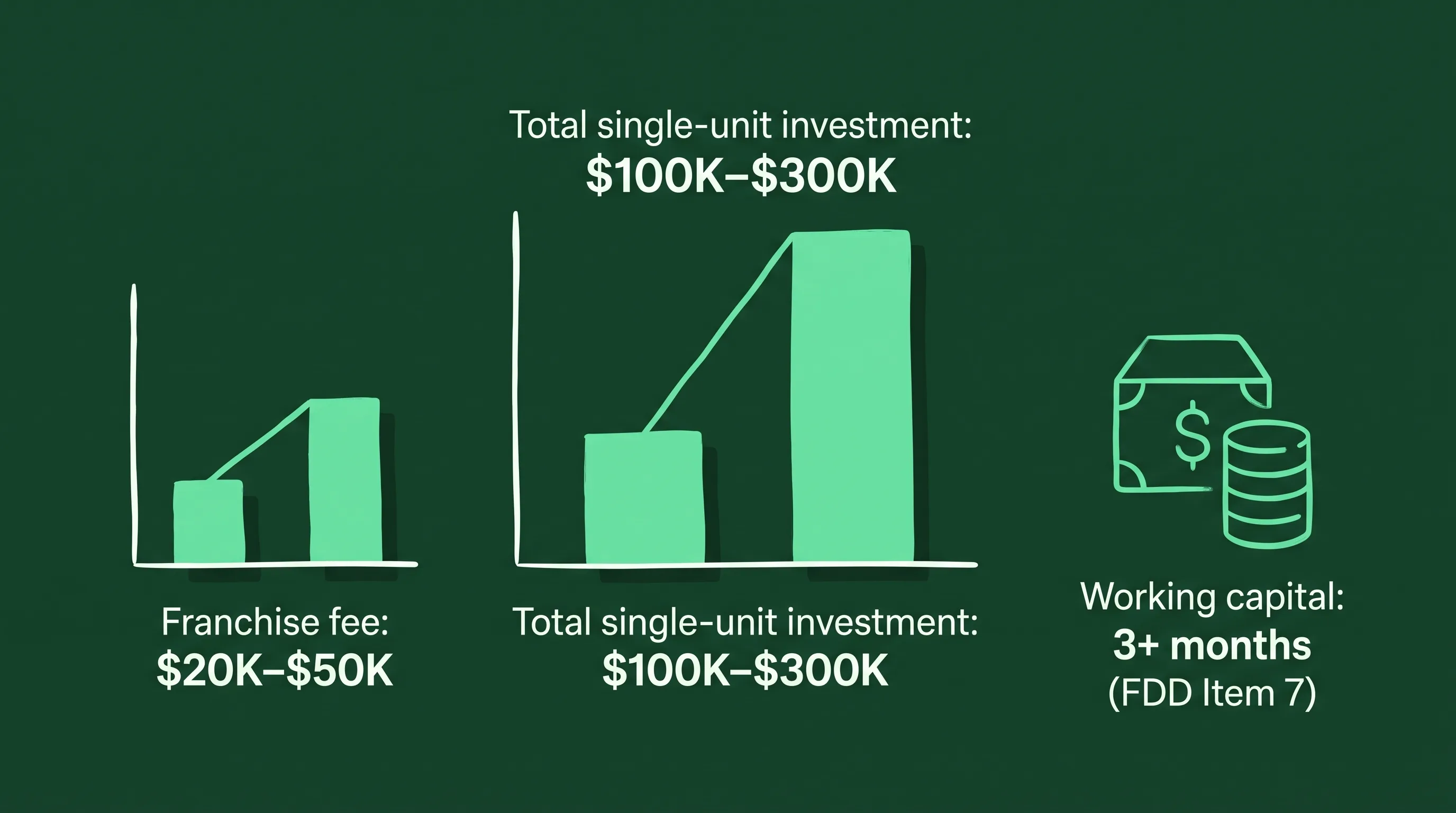
How much does a franchise cost depends heavily on category. A single-unit franchise commonly runs $100,000 to $300,000 in total investment, but food, childcare, and hotel concepts frequently exceed $1 million once real estate and construction are factored in. Here's how the ranges break down.

CategoryTotal InvestmentWhy
Home services$80K – $150KVans, tools, and licensing keep the floor low; fewer buildouts.
Retail / salon / boutique fitness$150K – $350KLeasehold improvements and inventory drive most of the range.
Fitness studios$150K – $500KEquipment and specialty buildout push the top end higher.
QSR / food & beverage$250K – $1M+Kitchen equipment, buildout, and signage are the big drivers.
Hotel / childcare / large-format food$1M+Real estate and construction scale can push well past $1M.
Master / area development$250K+Larger territory fee plus development obligations, not a single unit.

Ranges reflect typical total investment figures reported in franchise disclosure documents across categories. Individual brands vary — always confirm against the specific FDD Item 7 table for the concept you're evaluating.

The line items — where the money actually goes

Franchise startup costs break into nine recurring line items, and the franchise fee is only the first one. According to the SBA's guidance on franchise fees, that upfront fee typically runs $20,000 to $50,000 for a single unit and $100,000 or more for master or area development rights. Everything below it is where the franchise cost breakdown actually gets expensive.

Line ItemTypical Range / Notes
Franchise fee$20K – $50K (single unit); $100K+ for master/area rights
Build-out / leasehold improvementsVaries by concept — often the single largest line item
EquipmentKitchen, fitness, or service equipment specific to the concept
Opening inventoryInitial product stock to open doors
SignageInterior and exterior branded signage
Professional feesAttorney review of the FDD, accountant setup
Grand-opening marketingFranchisor-required local launch marketing
InsuranceGeneral liability, property, workers' comp
Additional Funds (Item 7)Working-capital buffer — FTC minimum is 3 months

On top of the startup investment, franchise fees continue after opening in the form of royalties — typically 4% to 12% of gross revenue, paid ongoing — plus a separate marketing fund contribution around 2%. Neither is a one-time cost. Both should be modeled into your operating budget from day one, not treated as an afterthought once the doors are open.

Where FDD Item 7 fits and why it's the number to trust

Item 7 of the Franchise Disclosure Document is the most reliable source for franchise startup costs — more reliable than franchisor marketing copy, because it's a legally mandated disclosure, not a sales pitch. Under the FTC Franchise Rule (16 CFR 436.5(g)), every franchisor must publish a table of estimated initial investment costs with low and high columns for each line item.

Read Item 7 the way an underwriter would: the low column is the best-case scenario, and the high column is closer to what actually happens once change orders, permitting delays, and real-world pricing enter the picture. The last row of the table — "Additional Funds" — is a mandated working-capital estimate covering the period from opening until the business can sustain itself. The FTC requires this figure to cover a minimum of three months, and it is frequently the line item buyers skim past fastest, even though it's the one that determines whether the business survives its first year.

Franchise startup costs infographic: franchise fee $20K–$50K, total single-unit investment $100K–$300K, and 3+ months working capital per FDD Item 7

The costs people underestimate

The single biggest gap between projected and actual franchise startup costs comes from treating the Item 7 Additional Funds figure as a real runway estimate instead of what it actually is: a regulatory floor. Franchisors set that number to satisfy the FTC's minimum, not to reflect how long it typically takes a new location to reach breakeven. Three months of working capital rarely covers the real ramp-up period for a new franchise location.

  • Pre-opening payroll

    Hiring and training staff before the doors open is a real cash outlay that many first-time buyers forget to budget separately from post-opening payroll.

  • Real estate and permitting delays

    Every month a build-out is delayed is a month of rent, loan payments, and living expenses with no revenue coming in. Delays extend the working-capital window well past the Item 7 minimum.

  • Franchisor liquid-cash minimums

    Many franchisors require a liquid-capital minimum separate from net-worth requirements — cash you must have on hand beyond what's financed. Confirm both figures before assuming your loan covers the full gap.

How people actually fund these amounts

Most franchise buyers combine more than one funding source to cover total franchise startup costs — few pay entirely in cash. Here are the paths that actually get used, with honest tradeoffs for each.

SBA 7(a) Loans

Best suited for larger builds that need government-backed financing. In FY2025, the SBA guaranteed roughly 77,600 7(a) loans totaling about $37 billion, with an average loan size near $477,571 (SBA loan program performance report). SOP 50 10 8, effective June 2025, tightened underwriting and equity-injection standards, so expect longer underwriting timelines and a documented down payment. Learn more about SBA franchise loans.

ROBS / 401(k) Rollover

A ROBS rollover deploys retirement funds as equity with no new debt and no early-withdrawal penalty, typically funding in 3-4 weeks. The tradeoff: it puts retirement assets at business risk and carries real IRS compliance obligations — a C-corp structure and ongoing plan administration. Our ROBS Compliance Guide covers what the IRS requires to keep the structure compliant.

Unsecured Credit Lines

Unsecured credit lines are a good fit for the working-capital gap — the Additional Funds shortfall — not the full build-out. Many carry a 0% introductory APR that converts to a standard rate after a set period, so they work best as a bridge, not a permanent capital source.

Personal Loans

Personal loans suit lower-capital concepts, particularly home-services franchises at the low end of the cost spectrum. Terms and rates depend heavily on personal credit, and loan amounts are typically smaller than what an SBA 7(a) or ROBS structure can provide.

Industry-wide, franchising output is projected to grow from $907.3 billion to $921.4 billion — about 1.6% — with establishments approaching 845,000 units, according to the IFA Franchising Economic Outlook. Growing demand means more competition for financing, so starting the funding conversation early matters.

FAQ: franchise cost and financing questions

How much does it cost to start a franchise with no experience?

Prior industry experience doesn't change the investment range — it changes financing terms in some cases (a few franchisors and lenders look favorably on relevant background). The total investment for a first-time owner runs the same $80K to $1M+ range depending on category. What experience does affect is how thoroughly a lender or franchisor scrutinizes your operating plan, not the sticker price.

What is the cheapest franchise to open, and what do budget franchises exclude?

Home-services and mobile-unit concepts tend to sit at the low end, often $80K to $150K total investment, because there's no leased retail space to build out. Budget figures usually exclude the FDD Item 7 working-capital buffer beyond the FTC's 3-month minimum, real estate costs if a location is added later, and any franchisor-required technology or vehicle upgrades that show up after year one.

What is a franchise royalty fee, and how is it different from the franchise fee?

The franchise fee is a one-time upfront payment — typically $20K to $50K — for the right to open under the brand. The royalty fee is an ongoing charge, usually 4% to 12% of gross revenue, paid monthly or weekly for the life of the agreement, plus a separate marketing fund contribution of roughly 2%. One is a startup cost; the other is a permanent line item in your operating budget.

How much cash do I need on hand versus how much can be financed?

Most SBA 7(a) lenders want to see a personal equity injection of roughly 10% to 20% of total project cost, with the remainder financed. ROBS (401(k) rollover) can cover a larger share of cash needs without new debt if you have sufficient retirement funds. Practically, plan on having liquid cash for the equity injection plus a reserve beyond what the loan covers — lenders scrutinize post-closing liquidity, not just the down payment.

How much does a franchise cost per month once it's open?

Ongoing monthly costs typically include royalties (4%-12% of revenue), a marketing fund contribution (around 2% of revenue), rent, payroll, insurance, and supply costs. There's no single figure — it scales with revenue — but franchisees should model royalty and marketing fund payments as a fixed percentage against realistic (not franchisor-projected) sales before signing.

Next steps: get a real number, not a franchise fee estimate

How much does a franchise cost comes down to three things: the category you're buying into, how honestly the FDD Item 7 table reflects real-world costs, and how much working capital you actually build in beyond the FTC minimum. Buyers who budget for the franchise fee alone are budgeting for a fraction of what they'll need.

An initial assessment from Fund My Franchise reviews your target concept's Item 7 numbers against your available capital and lays out realistic funding paths — SBA, ROBS, unsecured, or a combination. The initial assessment is free; what happens after depends on the scope of work.

Al Lesko, founder of Fund My Franchise

Al Lesko

Al Lesko has been in the franchise industry since 2009. As a certified franchise broker and the founder of Fund My Franchise, he works with prospective franchise owners on SBA loans, 401(k) rollovers, unsecured credit lines, and personal loans. See his full background at About Al.

Ready to find out what your
franchise will actually cost?

A free initial assessment with Al — a real number, not a franchise-fee estimate, and the funding paths that fit your file. No pressure, no obligation.

Free initial assessment
Soft credit pull only
No obligation