

DSCR for franchise loans compares cash flow available for debt payments with the principal and interest due over the same period. It helps answer a practical question: can the business support its borrowing after paying its operating costs?
A planning ratio depends on your assumptions. A lender verifies those inputs and reviews other credit requirements. This guide concerns financing a franchise business; it does not describe rental-property DSCR loan products.
What DSCR for franchise loans measures
Debt service coverage ratio (DSCR) measures payment coverage. Divide cash flow available for debt service, as defined for your calculation, by the principal-and-interest payments due during that same period.
DSCR = cash flow available for debt service ÷ principal and interest due
Match annual cash flow with annual payments, or monthly cash flow with monthly payments. Gross revenue, accounting profit, bank balances, and lender-adjusted cash flow are different measures. Ask which starting measure and adjustments your lender uses. The Chase business DSCR explanation describes the relationship between cash flow and required debt payments.
What 1.00x and 1.25x mean in dollars
A ratio of 1.00x means the defined cash flow exactly covers the defined debt payments. At 1.25x, the model has $1.25 available for every $1 of payments. Neither number establishes loan eligibility.
| Available annual cash flow | Annual principal + interest | DSCR | Balance after debt |
|---|---|---|---|
| $60,000 | $60,000 | 1.00x | $0 |
| $75,000 | $60,000 | 1.25x | $15,000 |
| $48,000 | $60,000 | 0.80x | −$12,000 |
The $15,000 cushion is 25% of the payments but 20% of the $75,000 cash-flow input. A 20% decline in that cash flow takes 1.25x to 1.00x, assuming unchanged payments. It does not mean the business can absorb a 20% decline in sales.
Treat 1.25x here as arithmetic, not a universal SBA minimum. SBA lists creditworthiness and reasonable repayment ability among its 7(a) eligibility requirements. A ratio alone cannot settle either question.
Build franchise loan cash flow from operating costs
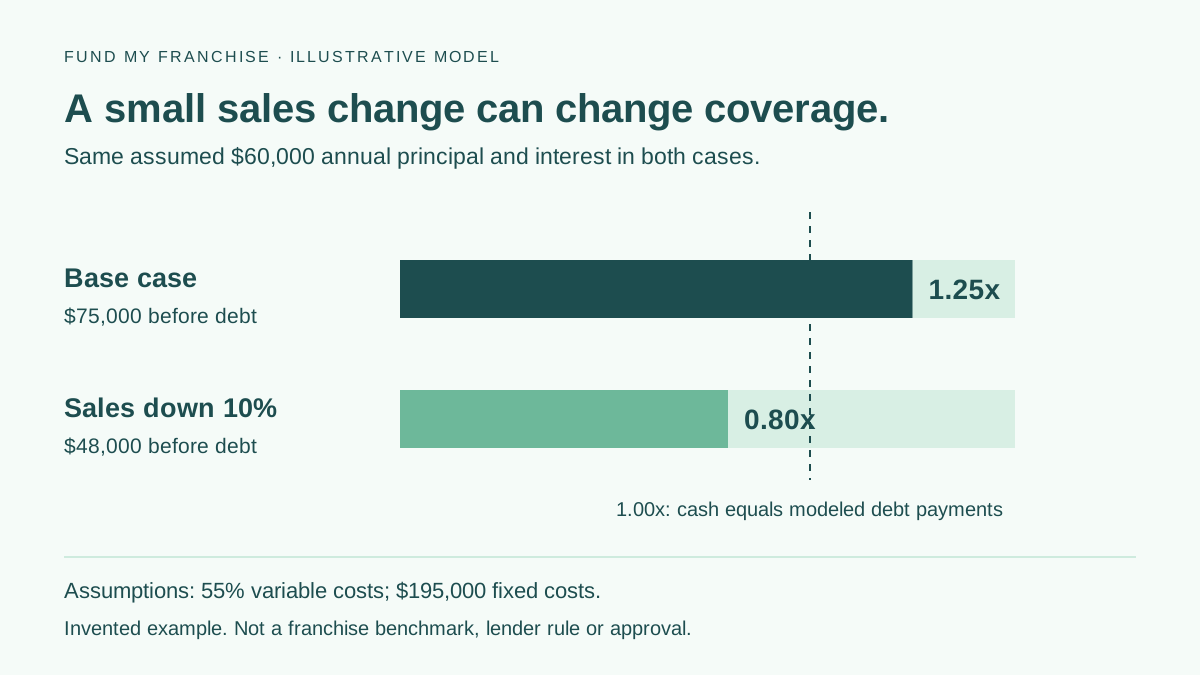
Start with the costs of running the location, including the labor someone must perform. Then change sales and see which costs actually fall. The example below assumes $600,000 of annual revenue and $60,000 of annual debt payments.
Every figure is invented for teaching. This is not a client result, franchise earnings representation, loan quote, or expected return. The fee percentages are assumptions, not franchise benchmarks. Taxes, reinvestment, and other adjustments may still need to be added to a real plan.
| Operating assumption | Base case | Sales down 10% |
|---|---|---|
| Revenue | $600,000 | $540,000 |
| Direct/variable costs: 45% of sales | $270,000 | $243,000 |
| Royalty: 6% of sales | $36,000 | $32,400 |
| Brand/local marketing: 4% of sales | $24,000 | $21,600 |
| Fixed payroll/owner-manager labor allowance | $105,000 | $105,000 |
| Rent, insurance, utilities, other fixed costs | $90,000 | $90,000 |
| Modeled cash flow before debt service | $75,000 | $48,000 |
| Modeled principal and interest | $60,000 | $60,000 |
| Illustrative DSCR | 1.25x | 0.80x |
| Modeled balance after debt | $15,000 | −$12,000 |
Costs tied to sales total 55%; the remaining 45% contributes toward $195,000 of fixed costs. Reducing sales by $60,000 removes $27,000 of cash flow. The numerator falls 36%, taking coverage from 1.25x to 0.80x. A modest revenue change can therefore create a much larger payment problem.
Use the actual franchise agreement and staffing plan. The FTC's franchise buying guide explains why royalty and advertising obligations matter; royalties may remain payable while a location loses money. Check minimum fees and avoid treating the owner's labor as free.
Why your lender may calculate a different DSCR
Lender review can change both the available-cash figure and the obligations it must cover. For example, Commerce Bank describes business, personal, and global coverage as distinct parts of its discussion. Ask what applies to your request.
| Reconcile this input | Bring this evidence | Ask the lender |
|---|---|---|
| Starting earnings measure | Statements, tax returns, forecast | Which measure and period should we use? |
| Noncash or one-time adjustments | Invoices, explanations, recurrence history | Which adjustments are supported and accepted? |
| Owner pay and replacement labor | Payroll, owner work plan, manager cost | Does the plan pay for all necessary labor? |
| Maintenance spending and taxes | Equipment needs, tax assumptions | What cash uses must reduce the numerator? |
| Existing loans and seller notes | Complete debt schedule and proposed terms | Which obligations belong in debt service? |
| Outside income and personal debts | Personal financial statement, household budget | Will you also review global repayment capacity? |
A seller calling an expense “one-time” does not establish an accepted add-back. Avoid counting interest twice or adding back an owner's salary while still requiring that person's labor. Outside income does not automatically cure weak business cash flow. Security Bank's business borrowing guide explains why cash-flow adjustments and other debt obligations deserve review.
Annual coverage can hide three weak months
Annual DSCR can look adequate while payments arrive before cash does. In a separate timing example, suppose three consecutive slow months each produce $2,000 of available cash flow. Nine stronger months produce about $7,666.67 each, bringing the annual total to approximately $75,000.
With $5,000 of debt payments due every month, each slow month has a $3,000 gap. Those three months require $9,000 of cash to bridge the payments alone, even though annual coverage is approximately 1.25x. Rounding explains the few cents in the stronger-month totals.
That $9,000 is not a complete reserve recommendation. Model actual collection dates, operating payments, and opening delays in a monthly franchise cash-runway plan. Test slower sales, higher costs, and variable-rate payment changes separately to understand each effect.
Prepare a plan someone else can review
A useful financing conversation starts with traceable assumptions. SBA's business-planning guidance calls for financial projections that explain their assumptions; established businesses can also provide historical statements.
- Connect each cost to a quote, agreement, staffing plan, or documented estimate.
- Prepare monthly projections, including the opening ramp and collection timing.
- List existing and proposed debts with their payment dates and terms.
- Keep a base case and a clearly labeled downside case.
- Separate business liquidity from household cash needs.
A new location's projections are not achieved results. A resale needs historical records reconciled with the buyer's proposed operations. Start with the Item 7 startup-budget guide, then discuss the file and applicable requirements for SBA franchise financing.
Questions about franchise loan payment coverage
What is a good DSCR for a franchise loan?
No single figure ensures approval. Ask your lender for the requirement applicable to the loan and its definition of cash flow and debt service. The 1.25x example above is arithmetic, not an eligibility rule.
Can franchise sales be used as the cash-flow input?
Gross sales are not cash available after operating costs. Build the expense model first, then reconcile the cash-flow input with your lender's accepted adjustments.
Does 1.25x mean there is enough cash every month?
No. An annual ratio can hide weak months and mismatched collection or payment dates. Review a monthly cash schedule alongside annual coverage.
Why might the lender's ratio differ from the calculator?
The lender may adjust earnings, include other debts, or review personal finances. FMF's planner divides your optional annual cash-flow input by annual payments on the modeled loan; it does not aggregate every obligation or perform underwriting.
Model the payment, then review the assumptions
Use the franchise funding calculatorwith a documented cash-flow input. Bring the operating budget, monthly timing, and debt schedule to the discussion. When you're ready to explore the financing options, Get Your Free Assessment. Consulting pricing depends on the scope of work.