
Size franchise working capital by forecasting when money enters and leaves the business, finding the largest cumulative shortfall, and choosing the cash balance you want left at that low point. A fixed number of months cannot answer that question on its own.
The worked example below starts with $70,000 of funded business cash. It shows why the same opening plan can stay above a chosen cash floor on schedule and run short after a two-month delay. Every figure is an invented teaching assumption, not a client result or franchise forecast.

Franchise working capital starts with cash timing
A balance-sheet measure and money available to pay Friday's payroll are different questions. Net working capital is current assets minus current liabilities. As Bank of America explains, those assets can include receivables and inventory as well as bank cash.
This guide forecasts spendable business cash. Record customer collections when they reach the bank, not simply when you book sales. If $30,000 is billed in June but $10,000 arrives in July, June receipts from those invoices are $20,000. July receives the remaining $10,000 once; do not count both the invoice and its later collection as cash.
Build a franchise cash flow schedule before opening
Begin with actual payment dates and documented estimates. The SBA's startup-cost guidance separates one-time expenses from recurring monthly costs. Keep that distinction when translating your Item 7 startup budget into a cash schedule.
- Start with funded, available business cash after separately funded one-time startup bills.
- Schedule rent commencement, training and staff payroll, suppliers, insurance, utilities, royalties, advertising fees and cash taxes.
- Put principal and interest payments on their actual dates, separately from operating payments.
- Forecast bank collections, including payment delays, rather than relying on sales alone.
- Add necessary owner compensation and keep household needs in a separate schedule.
Ask current and former operators which timing assumptions deserve scrutiny, then compare their experience with your lease, staffing plan and supplier terms. Extend your forecast through the relevant first operating year and seasonal troughs. The short example here demonstrates the method; it does not establish safety beyond its modeled period.
A month-by-month franchise working capital example
Assume $70,000 is available at the start of calendar month 1, with opening in month 2. Build-out, equipment and other committed one-time bills have separate funding. No additional borrowing, contributions or reimbursements arrive during the forecast.
Operating outflows include third-party payroll and applicable cash taxes, plus recurring business bills; they exclude debt service. Owner draws are zero in this illustration, and household cash is separate. Add your own necessary compensation in a real model. The $4,000 monthly loan payment starts in calendar month 1 by assumption. Confirm your actual disbursement, interest-only and repayment dates with the lender.
Net burn = operating outflows + debt service − receipts.
Closing cash = opening cash − net burn. Positive burn uses cash; negative burn adds it. Each following month opens at the previous closing balance.
Base case: opening in calendar month 2. All cash figures are $000; 43.5 means $43,500. Scroll horizontally to see every column.
| Calendar month | Stage | Opening cash | Cash receipts | Operating outflows | Debt service | Net burn | Closing cash |
|---|---|---|---|---|---|---|---|
| 1 | Pre-opening | 70 | 0 | 18 | 4 | 22 | 48 |
| 2 | Open month 1 | 48 | 20 | 30 | 4 | 14 | 34 |
| 3 | Open month 2 | 34 | 30 | 33 | 4 | 7 | 27 |
| 4 | Open month 3 | 27 | 40 | 36 | 4 | 0 | 27 |
| 5 | Open month 4 | 27 | 50 | 39 | 4 | −7 | 34 |
| 6 | Open month 5 | 34 | 60 | 42 | 4 | −14 | 48 |
| 7 | Open month 6 | 48 | 65 | 43.5 | 4 | −17.5 | 65.5 |
The lowest month-end balance is $27,000 in months 3 and 4. The largest cumulative cash deficit is therefore $43,000: $70,000 minus $27,000. If this buyer deliberately chooses a $20,000 remaining cash floor, required starting cash is $43,000 + $20,000 = $63,000. The funded $70,000 leaves $7,000 above that floor at the low point.
That $20,000 is a teaching choice, not a universal reserve benchmark or lender requirement. Select your floor with your advisers using the business's risks and payment timing. Month-end cash also hides intramonth problems: payroll can fall before collections. Check weekly or daily balances near the trough.
What a two-month opening delay does to the same cash
Move opening to calendar month 4 while keeping the same sales ramp after opening. Two extra pre-opening months each use $18,000 of recurring operating cash and $4,000 of debt service. This assumes those payments continue; actual contracts may behave differently.
Delayed case: opening in calendar month 4, with no additional funding. All cash figures are $000; 43.5 means $43,500. Scroll horizontally to see every column.
| Calendar month | Stage | Opening cash | Cash receipts | Operating outflows | Debt service | Net burn | Closing cash |
|---|---|---|---|---|---|---|---|
| 1 | Pre-opening | 70 | 0 | 18 | 4 | 22 | 48 |
| 2 | Delay month 1 | 48 | 0 | 18 | 4 | 22 | 26 |
| 3 | Delay month 2 | 26 | 0 | 18 | 4 | 22 | 4 |
| 4 | Open month 1 | 4 | 20 | 30 | 4 | 14 | −10 |
| 5 | Open month 2 | −10 | 30 | 33 | 4 | 7 | −17 |
| 6 | Open month 3 | −17 | 40 | 36 | 4 | 0 | −17 |
| 7 | Open month 4 | −17 | 50 | 39 | 4 | −7 | −10 |
| 8 | Open month 5 | −10 | 60 | 42 | 4 | −14 | 4 |
| 9 | Open month 6 | 4 | 65 | 43.5 | 4 | −17.5 | 21.5 |
Only the first two month-end balances stay above the chosen $20,000 floor. Month 3 ends at $4,000, and month 4 shows a $10,000 shortfall. Negative balances are unfunded forecast gaps, not money the business can spend. Later recovery in the table cannot happen as planned without resolving that gap first.
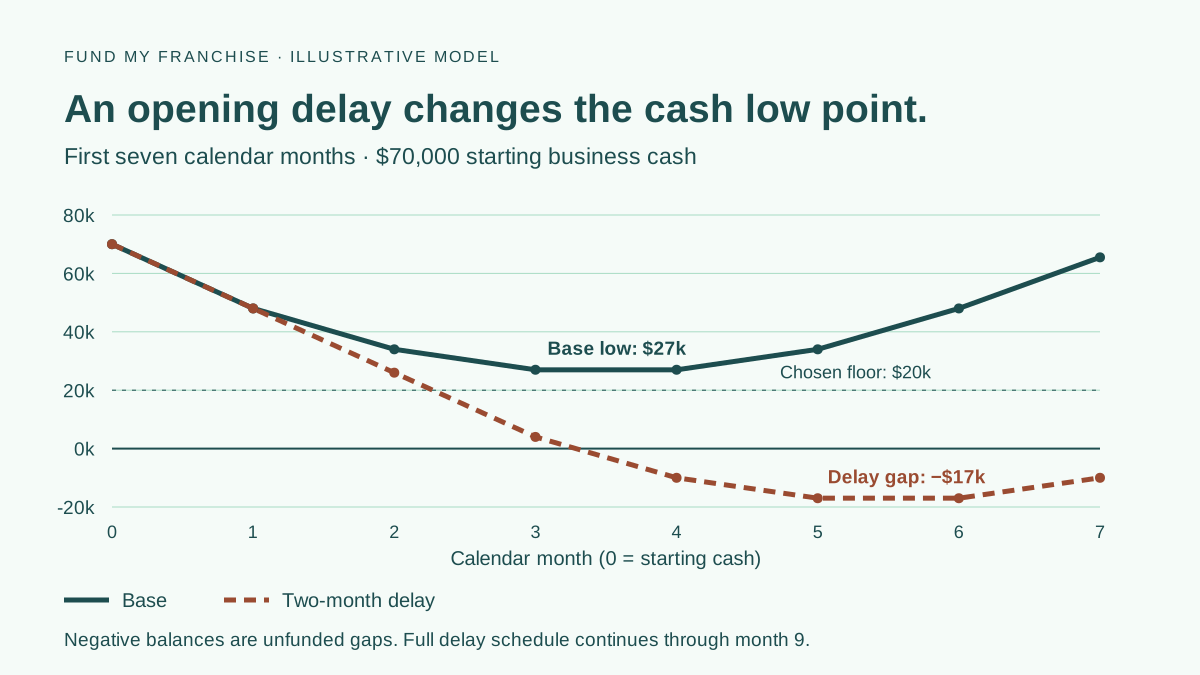
The peak cumulative deficit rises to $87,000. Add the same $20,000 floor and required starting business cash becomes $107,000. The delay adds $44,000 to the base requirement: two months at $22,000. Against the already funded $70,000, another $37,000 is needed to preserve the floor. Simply avoiding a negative month-end balance would need $17,000 more. Those are different objectives.
A second stress test could slow collections or increase payroll. Change one assumption at a time before combining stresses, so you can explain what caused the funding need.
Reconcile reserves with Item 7 and household cash
Replace overlapping allowances rather than adding the same costs twice. The FTC's Franchise Rule Compliance Guide, pages 48–49, explains that Item 7 Additional Funds uses a stated initial period and generally excludes the owner's salary or draw. Read your Franchise Disclosure Document's footnotes; a disclosure period does not establish adequate liquidity for your location.
Suppose a separate project budget already has a $50,000 operating-cash allowance covering exactly the same expenses and period. Replacing it with the base $63,000 adds $13,000 to total project cost. Replacing it with the delayed $107,000 adds $57,000. Do not add the full new reserve on top of the existing allowance, or subtract an entire Additional Funds line without checking its scope.
Identify any contingency already covering the delay and count it once. Then review personal cash and household runway separately. Business reserves, your cash contribution and money retained for living costs serve different purposes. One balance cannot fund all three simultaneously.
Bring the tested amount into your funding plan
Enter the reconciled operating-cash allowance in the planner's Working capital category. It estimates the funding gap, loan payment and personal cash retained; it does not forecast monthly runway. Its Cash retained result is available personal cash minus your contribution, not the business bank balance in these tables.
If you increase borrowing to fund reserves, recalculate debt payments and rerun the cash schedule. Keeping the assumed $4,000 payment while increasing the loan would overstate liquidity. Use the companion DSCR guide to test cash flow against loan payments alongside this calendar view.
Bring the base case, delay case and assumptions to your lender and Al. For an initial review of your funding options, Get Your Free Assessment. Any later consulting scope and pricing are separate.
Questions about franchise working capital
How much franchise working capital should I keep?
Model the largest cumulative cash deficit, then add a deliberate minimum remaining balance. Validate the costs, receipts and forecast period; a three- or six-month rule cannot settle the amount for every business.
Is Item 7 Additional Funds the same as my cash reserve?
It is the franchisor's estimate for its disclosed scope and period. Reconcile its footnotes with your calendar forecast and identify overlapping payroll, rent and other costs before changing the project budget.
Can SBA financing pay for franchise working capital?
The SBA lists working capital as an eligible 7(a) use. That does not establish your approval, available amount or funding date. Confirm those details and the repayment schedule with the lender before relying on the money.
What if opening is delayed after financing is arranged?
Reforecast actual rent, payroll, supplier and loan dates immediately. Identify the gap before further commitments; a bigger loan, payment holiday or new credit line cannot be assumed. Ask the lender what changes require review.