
BlogFunding Guide
Funding Guide

Financing a Franchise: 7 Funding Options Compared for 2026

Most buyers don't pick one funding source and stop there. Here's a real, side-by-side comparison of every option worth considering, what each one actually costs to use, and how buyers stack them to close the gap.

AL

Al Lesko

Fund My Franchise

10 min read

Franchise buyer comparing options for financing a franchise at a desk

Financing a franchise almost never means picking a single lender and signing one set of paperwork. Most buyers stack two or three funding sources — an SBA loan for the bulk of it, a rollover or a credit line to cover the equity injection, maybe a seller note for the rest. Anyone researching financing for a franchise for the first time usually starts with one question — "which loan do I get?" — when the more useful question is which combination fits their cash position, credit, and timeline.

This guide compares the seven realistic ways to finance a franchise in 2026, with actual dollar ranges, credit bars, and timelines instead of vague promises — plus the honest downside of each one, because every option here has one.

What Financing a Franchise Actually Involves

Financing a franchise covers a portion of total project cost, not all of it — and total project cost is bigger than the franchise fee alone. It's the franchise fee plus build-out, equipment, opening inventory, and a working capital buffer, all added together. For a full breakdown of what goes into that number, see how much it really costs to start a franchise.

Once that total is known, the financing question splits into two parts: how much of it a lender will finance, and how much the buyer has to bring personally. That second number — the equity injection — is what actually determines whether a deal is fundable, more than the total project cost itself.

The Number That Actually Gates You: Your Equity Injection

The gating number in franchise financing isn't the sticker price of the concept — it's the cash (or cash-equivalent) the buyer has to put in personally. Under SOP 50 10 8, effective June 2025, the SBA requires a minimum 10% equity injection of total project cost for start-ups and complete changes of ownership.

That 10% doesn't have to come from a savings account. It can come from ROBS-rolled retirement funds, a documented gift, or — on a limited basis — a seller note held on full standby. What it can't be is skipped. Buyers who structure their capital stack around the equity injection first, then work backward to financing for the rest, spend less time getting rejected by lenders mid-process.

7 Franchise Funding Options Compared

There are seven realistic franchise funding options available to most buyers in 2026, and they rarely get used one at a time. The table below compares amount, credit or equity bar, timeline, and the single downside worth knowing before choosing one.

OptionTypical AmountCredit / Equity BarTimelineDownside to Know
SBA 7(a) loanUp to $5M (up to $10M combined with a 504 loan)10% min. equity injection; strong personal credit60–90 daysMost paperwork, slowest close, personal guarantee required
ROBS (401(k)/IRA rollover)Limited to rollable funds (~$50K+ typically worth it)No credit check — it's your own money3–4 weeksRetirement savings become business risk
Unsecured credit / 0% intro cardsRoughly $10K–$150K+ depending on profile700+ typical; some online lenders go lowerDays to ~2 weeksIntro rate reverts to standard revolving rates
Personal loansSmaller gap-filling amountsRate driven entirely by credit profileDays to ~2 weeksRates commonly 8%–36% APR; a supplement, not primary
Home equity / HELOCBased on available home equityUnderwritten like any HELOC2–6 weeksYour home is the collateral if the business fails
Seller / franchisor financingVaries entirely by brandNegotiated during FDD reviewVariesCaps at 50% of required equity injection, on standby
Equipment financing / leasingCost of the equipmentTied to equipment and business profileDays to weeksCovers equipment only, not total project cost
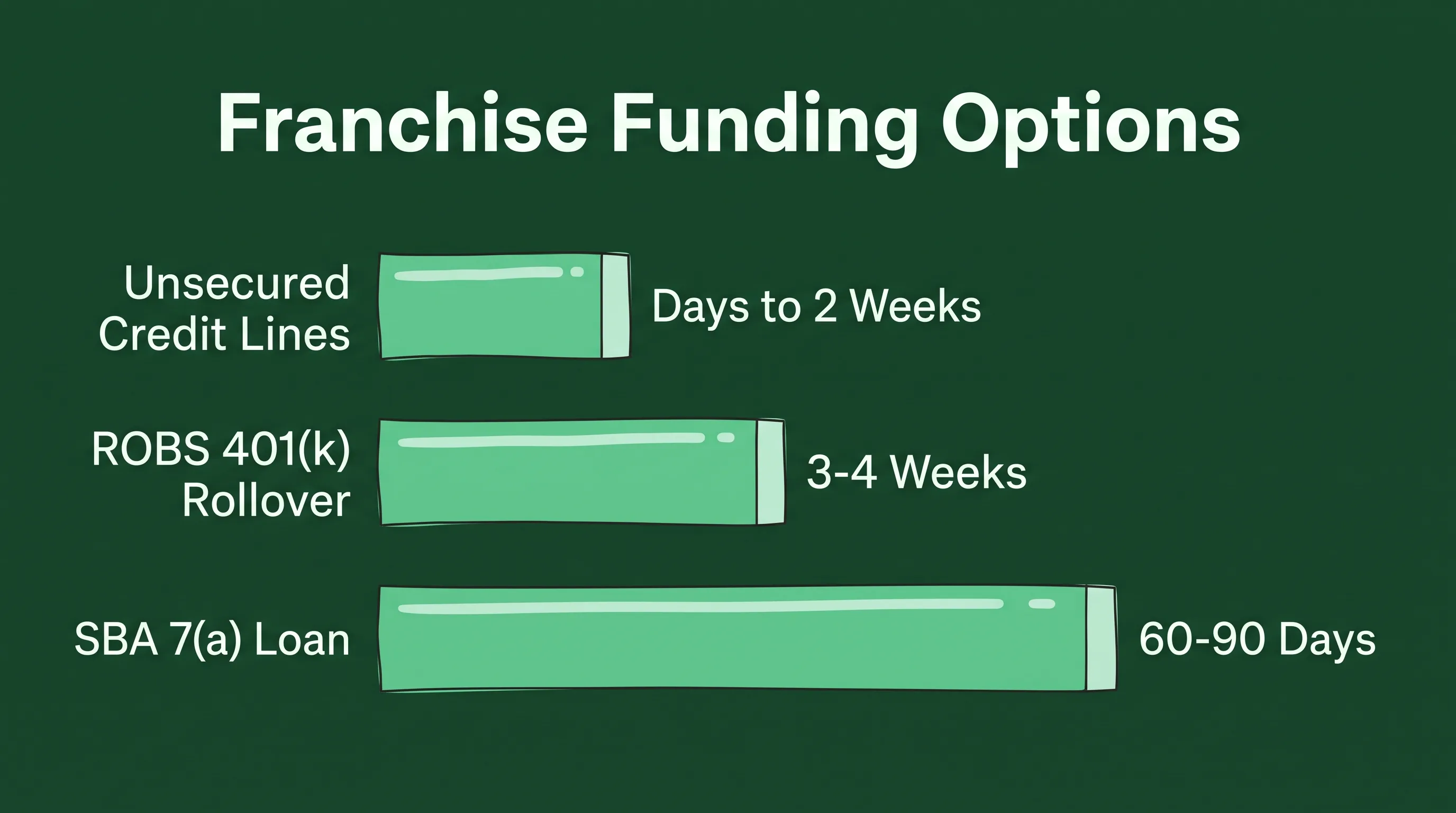
Infographic comparing timelines for franchise funding options, from unsecured credit lines to SBA 7(a) loans

Home equity / HELOC

A HELOC is underwritten like any home equity line — based on available equity, income, and credit. It can move fast and cover a meaningful share of the equity injection or working capital. Said plainly: the home is the collateral if the business fails, so this option concentrates risk rather than spreading it.

Seller / franchisor financing

Some franchisors or resale sellers will carry part of the purchase price. Terms vary entirely by brand — it's a question to raise during FDD review, not something to assume. Under current SBA rules, a seller note can satisfy at most 50% of the required equity injection, and only while held on full standby for the term of the SBA loan.

Equipment financing / leasing

Equipment loans and leases are term-matched to the equipment's useful life, which keeps cash free for the equity injection instead of tied up in a walk-in cooler or a POS system. It covers equipment only — not build-out, working capital, or the franchise fee. Two smaller, niche additions worth knowing: friends-and-family loans, which should be documented like a real loan with terms in writing, and securities-backed lines, which let a buyer borrow against an investment portfolio without liquidating it.

SBA 7(a) Loans: The Default Path for Most Buyers

SBA 7(a) financing is the default path for most franchise buyers because it's the only option built to fund the full capital stack — franchise fee, build-out, equipment, and working capital — in one loan. The SBA 7(a) program caps individual loans at $5 million. As of a rule effective July 4, 2026, eligible borrowers who take a 7(a) loan first can combine it with a 504 loan for up to $10 million in total SBA-backed financing — that combined figure is a cumulative ceiling across both programs, not a new 7(a) cap on its own.

SBA franchise financing carries three real requirements worth knowing going in. First, the minimum 10% equity injection described above. Second, the franchisor has to appear on the SBA Franchise Directory with a signed SBA Form 2462 at closing — not every brand qualifies, and buyers should confirm this before falling in love with a concept. Third, realistic timelines run 60 to 90 days from application to funding, longer than every other option on this list. The tradeoff for that timeline and paperwork is the largest, most complete financing available, backed by a personal guarantee. For credit specifics, see what score actually moves an SBA franchise loan application forward, and explore SBA franchise loans in more depth.

Using Retirement Funds Without a Taxable Withdrawal (ROBS)

ROBS lets a buyer invest 401(k) or IRA funds into a new franchise without an early-withdrawal penalty or income tax, by rolling the funds into a qualified plan sponsored by a newly formed C-corp. It's a legitimate, IRS-recognized structure — but it converts retirement savings into direct business risk, and that tradeoff deserves to be stated plainly, not buried. The IRS's own ROBS Compliance Project found that among the ROBS-funded businesses it studied, many had failed within roughly three years, with some ending in bankruptcy or dissolution. That's retirement savings, not a bank's money, absorbing that risk.

Practically, ROBS generally needs at least around $50,000 in rollable retirement funds to be worth the structure, since setup and ongoing third-party plan administration — typically around $100 to $200 per month — eat into smaller balances fast. There's no credit check, since it's the buyer's own money, and funding is typically faster than SBA financing, running 3 to 4 weeks. It's frequently used to cover the equity injection on an SBA loan rather than the entire project cost. Learn more about 401(k) rollover financing and read the ROBS compliance guide for what the IRS requires to keep the structure compliant after closing.

Credit-Based Financing: Lines, Cards, and Personal Loans

Credit-based options are the fastest way to finance a franchise, but they're built for bridging a gap, not carrying the whole project. Unsecured business credit lines and 0% introductory-APR business cards typically provide roughly $10,000 to $150,000 depending on the applicant's profile, with strong applicants qualifying for more. Banks generally want a 700+ credit score; some online lenders will go lower. Approval is the fastest of any option here — days to about two weeks.

The catch is the intro period. 0% introductory rates commonly run about 12 to 18 months before reverting to standard revolving rates, so this works best as a bridge or as one piece of the equity injection, not as primary financing for the full build-out. Explore unsecured lending options for the specifics.

Personal loans fill smaller gaps and are almost always a supplement rather than primary financing. According to Bankrate's personal loan data, rates commonly range from roughly 8% to 36% APR depending on credit profile — general personal-loan market data, not franchise-specific. See personal loan options for how this fits smaller concepts.

How Buyers Actually Stack Their Financing

Buyers stack financing by matching each source to the part of the capital stack it's actually good at. A common pattern: an SBA 7(a) loan covers the majority of total project cost, a ROBS rollover or a documented gift supplies the 10% equity injection so no new debt is added on top of the loan, and a modest unsecured credit line sits in reserve for the working-capital buffer beyond what the SBA loan and Item 7 Additional Funds figure cover.

A different buyer with a smaller concept — a home-services franchise with a lower total investment — might skip SBA financing altogether and combine a personal loan with equipment financing, avoiding the 60-to-90-day SBA timeline entirely. There's no single correct capital stack. The right combination depends on total project cost, how much is sitting in retirement accounts versus liquid savings, and how fast the buyer needs to close.

Building a Fundable Profile Before You Apply

A fundable profile comes down to three things a lender can verify quickly: credit history, documented cash for the equity injection, and a realistic read of the target concept's FDD before applying anywhere. Buyers who build these before shopping lenders move through underwriting faster than buyers who start cold.

Business credit — separate from personal credit — matters more than most first-time buyers expect, since it affects both loan terms and the unsecured credit lines used to fill gaps. The business credit guide and 6 benefits of borrowing right cover how to build that profile before it's needed, not during a time-sensitive application. Questions about the process in general are answered on the FAQ page, and background on Fund My Franchise's approach is on the About page.

Frequently Asked Questions About Financing a Franchise

Can you finance a franchise with no money down?

Essentially no, for an SBA-backed deal — SOP 50 10 8 requires a minimum 10% equity injection of total project cost for start-ups and complete changes of ownership, and that requirement doesn't disappear just because the rest is financed. What can change is where that 10% comes from. It doesn't have to be personal savings — a ROBS rollover, a gift from a qualified source, or a seller note on full standby can supply part or all of the injection, as long as the structure meets SBA rules.

Can you use an SBA loan to buy an existing franchise?

Yes. SBA 7(a) loans cover both new franchise openings and the purchase of an existing, operating franchise location, including complete changes of ownership. The equity injection and underwriting requirements apply either way, and the franchisor still has to appear on the SBA Franchise Directory with a signed SBA Form 2462 at closing for the loan to qualify.

What credit score do you need for financing a franchise?

It depends heavily on which funding source is doing the heavy lifting — SBA lenders, unsecured credit issuers, and personal-loan lenders each set their own bar. For a full breakdown of what SBA lenders actually look for and how it's evaluated, see the dedicated post on the credit score needed for an SBA franchise loan.

How long does franchise financing take to approve?

It ranges from days to about three months depending on the source. Unsecured credit lines and cards are the fastest, often approved within one to two weeks. ROBS rollovers typically take three to four weeks to fund. SBA 7(a) loans are the slowest, realistically running 60 to 90 days from application to funding once underwriting, the franchisor's SBA eligibility, and closing are factored in.

Can you use a 401(k) to buy a franchise without paying a tax penalty?

Yes, through a ROBS (Rollovers as Business Start-ups) structure, which is an IRS-recognized way to invest retirement funds into a new C-corp business without triggering an early-withdrawal penalty or income tax on the rollover. It is a legitimate structure, but it converts retirement savings into direct business risk and carries real ongoing compliance obligations — it is not a loophole to be used casually.

Next Steps

Financing a franchise comes down to matching sources to the capital stack — SBA for scale, ROBS or credit for the equity injection, and a supplemental source or two for the working-capital gap. The options that look fastest often cover the least, and the option that covers the most takes the longest to close.

An initial assessment reviews the target concept's total project cost against available cash, retirement funds, and credit, then lays out which combination of these seven options actually fits. The assessment itself is free — what happens after depends on the scope of work.

Al Lesko, founder of Fund My Franchise

Al Lesko

Al Lesko has been in the franchise industry since 2009. As a certified franchise broker and the founder of Fund My Franchise, he works with prospective franchise owners on SBA loans, 401(k) rollovers, unsecured credit lines, and personal loans. See his full background at About Al.

Ready to find the right combination for
financing your franchise?

A free initial assessment with Al reviews your target concept's total project cost against your cash, retirement funds, and credit — and lays out the funding paths that actually fit. No pressure, no obligation.

Free initial assessment
Soft credit pull only
No obligation