
BlogROBS 401(k) Rules
ROBS

ROBS 401(k) Rules: How It Works, Who Qualifies, Pros & Cons

A ROBS 401(k) lets you fund a franchise with retirement savings — no loan, no interest, no early-withdrawal penalty. Here are the real ROBS 401(k) rules: how it works, who qualifies, what it costs, and the risk most articles gloss over.

AL

Al Lesko

Fund My Franchise

10 min read

Business owner reviewing ROBS 401(k) rules and retirement paperwork alongside a franchise agreement

Every year, prospective franchise owners use retirement savings to fund a business — without a loan, without paying income tax on the money, and without the 10% early-withdrawal penalty. The structure that makes this possible is called Rollover as Business Start-ups, or ROBS. Understanding the ROBS 401(k) rules up front is the difference between a compliant structure that survives IRS scrutiny and one that unravels years later at real cost.

This guide covers how a ROBS 401(k) plan works step by step, who actually qualifies, the core ROBS 401(k) requirements the IRS enforces, and an honest look at the pros and cons — including the retirement-risk downside that search results for "robs 401k nightmare" are really asking about. Officially, the IRS refers to this as a rollover for business startups irs arrangement, and its published guidance is the backbone of every rule covered below.

What is a ROBS 401(k)?

A ROBS 401(k) is a funding structure — not a loan — that lets someone use retirement funds to buy stock in a new C-corporation, which then uses that cash to fund a business. ROBS stands for Rollover as Business Start-ups. Done correctly, the rollover triggers no income tax and no 10% early-withdrawal penalty, because the money moves directly between qualified retirement plans rather than being distributed to the individual.

It helps to be precise about what a ROBS 401(k) is not. It's not a 401(k) loan — there's no repayment schedule and no interest owed back to the plan. And it's not a withdrawal — the funds never pass through the individual's hands as taxable income. Instead, the ROBS 401(k) rules require the funds to roll into a newly adopted plan that then purchases employer stock, converting retirement dollars into business equity.

That last point is the key takeaway: a ROBS 401(k) converts protected, tax-advantaged retirement savings into at-risk business equity. It's a legitimate, IRS-recognized structure — but it changes what that money is exposed to. Anyone comparing funding options should read that tradeoff alongside the other paths in financing a franchise, since ROBS is rarely the only piece of a buyer's funding stack.
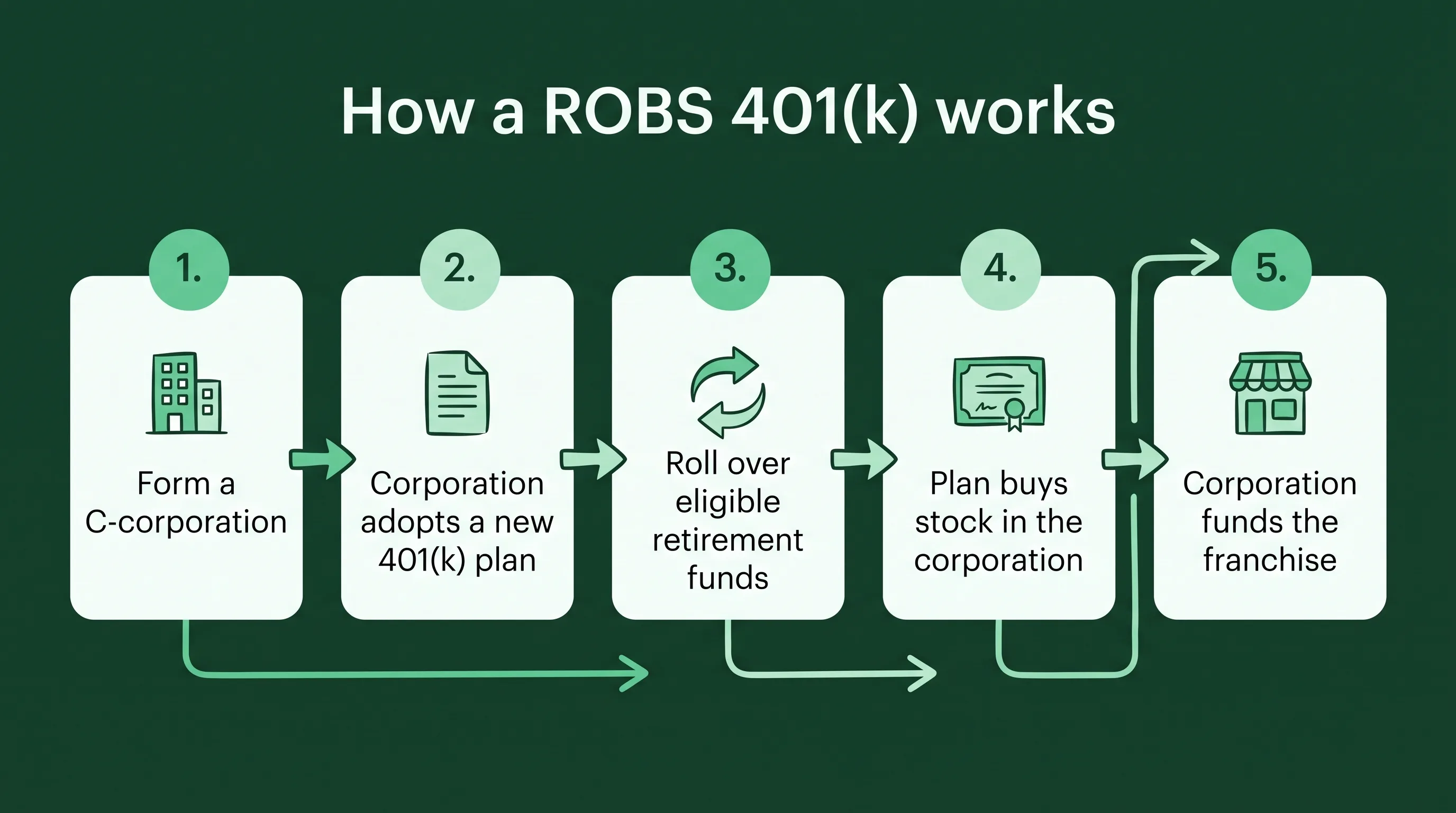

How does a ROBS 401(k) work, step by step?

A ROBS 401(k) works through five sequential steps: form a C-corporation, adopt a new 401(k) plan inside that corporation, roll eligible retirement funds into the plan, have the plan purchase stock in the C-corp, and use the resulting cash to buy or fund the business. Skipping a step or using the wrong entity type is what turns a compliant rollover into a taxable event.

1

Form a C-corporation

The business must be structured as a C-corp — not an LLC, S-corp, or sole proprietorship. This is a hard requirement of how a ROBS 401(k) plan is legally built.

2

The C-corp adopts a new 401(k) plan

The new corporation sponsors its own retirement plan, which must be offered to eligible employees, not just the owner.

3

Roll eligible retirement funds into that plan

Pre-tax funds move from the individual's prior retirement account into the new C-corp's 401(k) via a direct, trustee-to-trustee rollover.

4

The plan buys stock in the C-corp

The 401(k) plan purchases newly issued shares of the C-corporation at a fair market value supported by an independent business valuation.

5

The corporation funds the franchise

The cash the corporation receives from the stock sale is used to pay the franchise fee, build-out costs, equipment, and working capital.

The order matters as much as the steps themselves — forming the C-corp after the rollover, or using the wrong entity type, can void the tax-free treatment. For the six operational issues the IRS scrutinizes most closely once the structure is live, see the ROBS compliance guide.

Who qualifies for a ROBS 401(k)?

Eligibility comes down to two things: having the right kind of retirement funds, and being willing to become a genuine W-2 employee of the new corporation. Eligible sources include a 401(k), 403(b), 457(b), traditional IRA, SEP IRA, SIMPLE IRA, or a plan from a prior employer. These are the robs ira rules and robs 401k requirements that determine whether a rollover is even possible before the structure gets built — and the traditional IRA piece is where the ira robs pairing shows up most often for buyers who left the workforce or are self-employed.

One nuance trips people up: funds generally have to come from a former employer's plan or an account unrelated to a current employer. You typically cannot roll an active 401(k) from the job you still hold, though limited in-service rollover exceptions exist depending on the plan's own rules. This is one of the most misunderstood robs ira rules — people assume any retirement account qualifies, and it doesn't. Because a traditional IRA rolls in cleanly, ira robs combinations are common among buyers consolidating an old 401(k) into an IRA first, then rolling that IRA into the new plan.

Roth accounts are the clearest exclusion. Roth IRA and Roth 401(k) balances do not qualify for a ROBS rollover, because they hold after-tax dollars and the structure is built around pre-tax retirement funds. On the practical side, most providers want roughly $50,000 or more in rollable assets before the structure makes financial sense — that's an industry norm driven by setup and ongoing administration costs, not an IRS rule. And finally, the owner must become a bona fide W-2 employee of the C-corp, drawing a real salary and doing real work — not a passive investor collecting stock. Anyone still building out their total project budget should also read how much cash you need to buy a franchise to see where ROBS funds typically fit into the larger capital stack.

Infographic of the five ROBS 401(k) rules steps: form a C-corporation, adopt a new 401(k) plan, roll over eligible retirement funds, plan buys stock in the corporation, corporation funds the franchise

The core ROBS 401(k) rules

A handful of ROBS 401(k) rules govern the structure for as long as it exists, not just at setup. Missing any of these is what turns an audit into a problem instead of a routine check.

  • C-corporation required

    The business must be a C-corp. An LLC or S-corp cannot hold the plan's stock purchase under ROBS 401(k) rules.

  • Active operating business

    The company must be an active operating business, not a passive real estate holding or investment vehicle.

  • Reasonable W-2 salary

    The owner must draw a reasonable salary and actually work in the business — this is a core robs 401k requirement the IRS checks closely.

  • Nondiscriminatory plan access

    The 401(k) plan must be offered to other eligible employees on nondiscriminatory terms, not reserved for the owner alone.

  • No personal use of business assets

    Disqualified persons — the owner included — cannot use business assets for personal benefit. IRC 4975 prohibited transactions carry a 15% excise tax.

  • Form 5500 filing

    Once plan assets exceed $250,000, the plan must file Form 5500 or Form 5500-EZ annually.

  • Annual independent valuation

    An independent business valuation each year supports the fair value of the stock the plan holds.

These rules exist because ROBS structures faced heightened IRS attention after a 2008–2009 review project. For the full breakdown of the six operational issues examiners focus on today, see the ROBS compliance guide. The IRS's own ROBS Compliance Project page and its 2008 ROBS guidelines memo are the source documents behind this scrutiny — useful background for anyone who wants the rollover for business startups irs framework straight from the agency rather than a secondhand summary.

FeatureROBS 401(k)401(k) LoanEarly Withdrawal
Repayment requiredNoYes, with interestNo
Income tax owedNo, if done correctlyNo, if repaid on scheduleYes
10% early-withdrawal penaltyNoNoYes, if under 59½
Typical amount availableFull rollable balanceLesser of $50,000 or 50% of vested balanceAny amount, minus tax and penalty
Ongoing compliance burdenYes — annual filings, valuationNone beyond repaymentNone

ROBS 401(k) pros and cons

Weighing ROBS 401(k) pros and cons honestly means naming the upside and the real risk in the same breath. The structure isn't right or wrong — it's a tradeoff between avoiding debt and putting retirement savings directly on the line.

ProsCons
No debt or interest paymentsRetirement savings are directly at business risk — largely gone if the business fails
No 10% early-withdrawal penaltyOngoing compliance and administration for the life of the structure
Preserves personal cash and creditUnwinding at sale or exit follows a defined process, not a simple payout
Can cover the SBA equity injectionIRS and DOL scrutiny is real since the 2008 compliance project
Faster than saving up the capitalOwner must remain a genuine active employee, not a passive investor

The phrase "robs 401k nightmare" shows up in search because the downside is real and worth stating plainly: if the business fails, the retirement funds invested as stock are largely gone — there's no FDIC protection, no creditor-shielding of the kind a never-touched 401(k) enjoys. Anyone considering ROBS 401(k) pros and cons should treat that as the central question, not a footnote.

Timeline and typical costs

A ROBS 401(k) typically takes about 3 to 4 weeks from engagement to a funded stock purchase, though the real range runs from roughly 10 days to several weeks depending on the provider and how quickly the prior custodian releases the funds. Custodian delays are the most common timeline variable — some prior-employer plans move in days, others take weeks to process a rollover request.

On cost, industry pricing typically runs a one-time setup fee of roughly $3,000 to $5,000, based on publicly available provider pricing, plus ongoing plan administration fees billed monthly or annually for as long as the structure remains active. These are typical industry ranges — Fund My Franchise doesn't quote a flat fee here, because pricing depends on the scope of work involved in a given engagement. For a fuller picture of how this fits into total startup costs, see how much cash you need to buy a franchise.

When ROBS is a bad idea

ROBS isn't the right call for everyone, and saying so plainly is part of understanding the ROBS 401(k) rules honestly. A few situations should give any prospective buyer pause before rolling retirement funds into a franchise.

  • A thin retirement cushion with nothing else saved — rolling the entire nest egg into one business leaves no fallback if the venture struggles.
  • An unproven or high-risk business plan, where the odds of success don't justify putting retirement savings directly at risk.
  • An owner unwilling to run a real qualified plan — Form 5500 filings, nondiscrimination testing, and annual valuations aren't optional paperwork.
  • A passive business the owner doesn't intend to work in day to day — ROBS 401(k) rules require active employment, not a silent-partner arrangement.
  • Any situation where the owner won't become a genuine active W-2 employee of the C-corp.

How ROBS fits with SBA loans and other financing

ROBS proceeds commonly serve as some or all of the equity injection an SBA lender requires before approving the rest of a franchise loan. Rather than draining personal savings for the down payment, a buyer can use ROBS funds to cover the equity piece and finance the remainder through SBA 7(a) debt — keeping personal cash in reserve as working capital.

ROBS is one option among several, not the only one. The full comparison of seven funding options — SBA 7(a), ROBS, unsecured credit, personal loans, HELOC, seller financing, and equipment leasing — lays out where each one fits. To model a specific deal, the SBA loan calculator shows how a ROBS-funded equity injection changes the monthly payment on the remaining loan balance.

FAQ: ROBS 401(k) rules

What is a ROBS 401(k) and how is it different from a 401(k) loan?

A ROBS 401(k) — Rollover as Business Start-ups — is a funding structure that lets someone roll eligible retirement funds into a new C-corp's 401(k) plan, which then buys stock in the corporation to capitalize a business. It is not a loan: there is no repayment schedule, no interest, and no debt on the corporation's books. A 401(k) loan, by contrast, is borrowed against an existing plan (capped around $50,000) and must be repaid with interest, typically within five years, or it is treated as a taxable distribution.

How does a ROBS 401(k) work step by step?

The business owner forms a C-corporation, the C-corp adopts a new 401(k) plan, eligible retirement funds are rolled into that plan, the plan uses the funds to buy stock in the C-corp, and the corporation uses the resulting cash to fund the franchise purchase. Each step has to happen in that order and through the correct entity type for the rollover to stay penalty-free.

What are the pros and cons of a ROBS 401(k)?

The main advantages are no debt, no interest, no early-withdrawal penalty, and the ability to preserve personal cash and credit while covering an SBA loan's equity injection. The main drawbacks are that retirement savings become at-risk business equity, the structure requires ongoing plan administration and compliance for as long as it exists, and unwinding it at sale or exit follows a defined process rather than a simple payout.

Can you use a Roth IRA or Roth 401(k) for a ROBS rollover?

No. Roth accounts hold after-tax dollars, and ROBS 401(k) rules require pre-tax retirement funds — a traditional 401(k), 403(b), 457(b), traditional IRA, SEP IRA, or SIMPLE IRA. Roth IRA and Roth 401(k) balances do not qualify for the rollover.

How long does a ROBS 401(k) take to set up and what does it typically cost?

Most ROBS 401(k) structures fund in roughly 3 to 4 weeks from engagement to the completed stock purchase, though the range runs from about 10 days to several weeks depending on the provider and how quickly the prior custodian releases funds. Industry pricing typically runs a one-time setup fee of roughly $3,000 to $5,000, plus ongoing plan administration fees billed monthly or annually. These are general industry ranges, not a Fund My Franchise quote — actual cost depends on scope.

Al Lesko, founder of Fund My Franchise

Al Lesko

Al Lesko has been in the franchise industry since 2009. As a certified franchise broker and the founder of Fund My Franchise, he works with prospective franchise owners on SBA loans, 401(k) rollovers, unsecured credit lines, and personal loans. See his full background at About Al.

Weighing a ROBS 401(k)
against your other options?

A free initial assessment with Al reviews your retirement accounts, credit, and the realistic funding paths — ROBS, SBA, or a stack of both — before you commit to anything.

Free initial assessment
Soft credit pull only
No obligation