
HomeFranchise Funding by IndustryHVAC
HVAC Franchises

How to Fund an HVAC Franchise

What an HVAC franchise really costs, from the franchisors' own disclosure documents, and how buyers fund a business built on trucks, technicians and peak-season demand.

$101K–$289K

Published startup range

4 of 4

Brands on the SBA directory

$50K–$150K

Liquid capital asked

Al Lesko, founder of Fund My Franchise

Al Lesko

Fund My Franchise

Updated

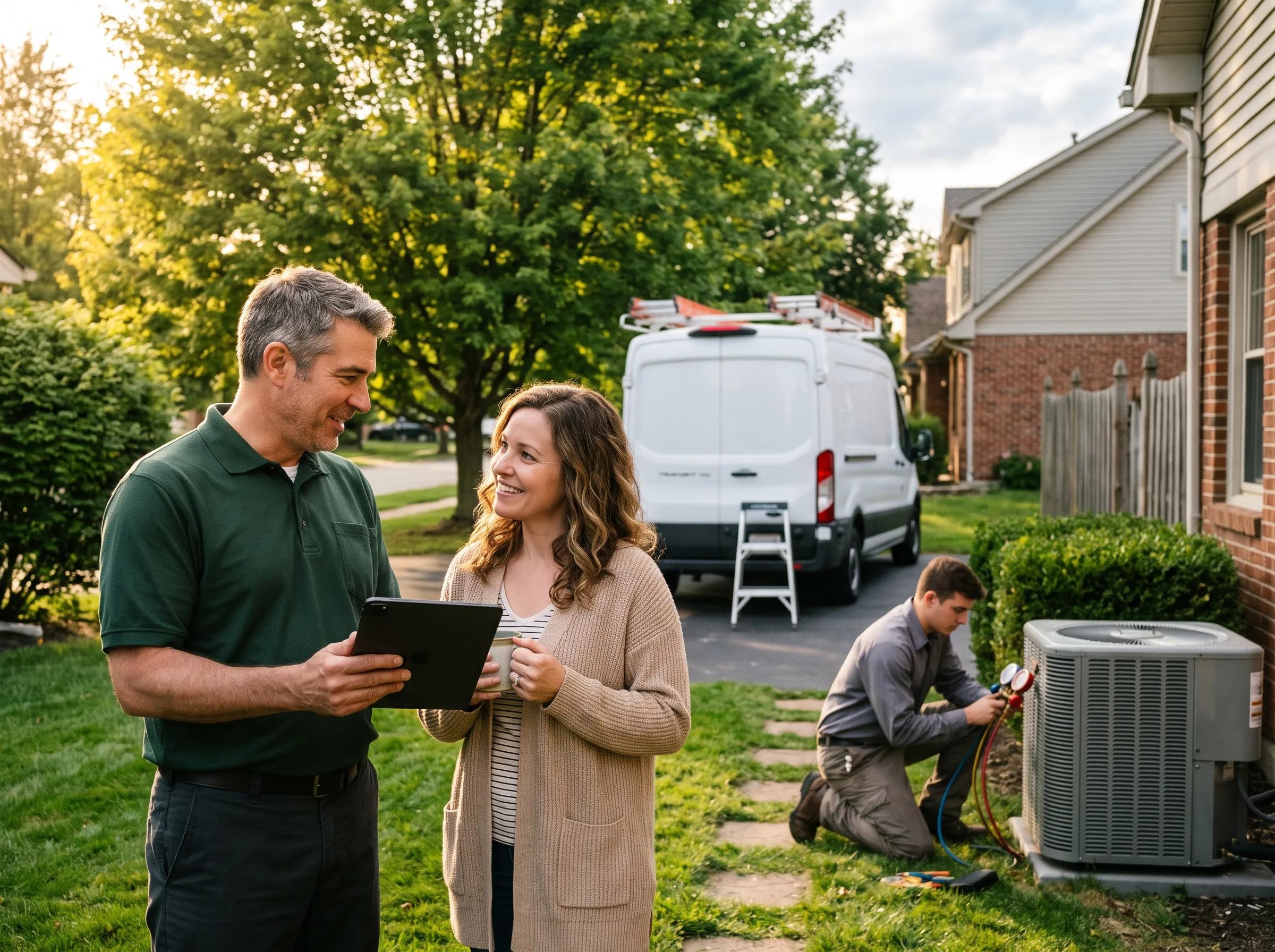
HVAC franchise owner reviewing a maintenance plan with a homeowner while a technician services the outdoor unit

The short answer

An HVAC franchise costs roughly $101,000 to $289,000 to open, based on the published Item 7 estimates of four national brands. Most buyers fund one with an SBA 7(a) loan, often using a 401(k) rollover for the cash injection, and keep a credit line for parts and the payroll swings of peak season.

How much does an HVAC franchise cost?

Every franchisor publishes an estimated initial investment in Item 7 of its Franchise Disclosure Document (FDD). Here is what four national HVAC franchises list today.

BrandTotal investmentFranchise feeAdditional fundsLiquid capital
Heating + Air Paramedics$100,935 – $193,260$40,000Not broken out on the pageNot published
Aire Serv$113,809 – $271,709Varies by territoryNot broken out on the page$50,000
One Hour Heating & Air Conditioning$143,273 – $286,702$43,000 (up to 100K population)Not broken out on the pageNot published
Service Experts$148,750 – $288,900$59,900$30,000 – $70,000 (3 months)$150,000

Figures from each franchisor's investment page, checked November 24, 2026. FDDs are reissued every year; get the current FDD from the franchisor before you budget.

The spread comes from territory size, how many trucks you start with, and whether you open from scratch or convert an existing shop. Service Experts publishes a separate conversion estimate of $129,500 to $230,900, and Aire Serv offers roll-in discounts for existing HVAC businesses.

Where does the money go?

An HVAC franchise is a service business built on trucks, trained technicians and local marketing. Vans and tools give lenders a little collateral, but most of the money goes to the franchise fee, launch marketing and the cash that carries payroll until service calls build.

  • Franchise fee

    About $40,000 to $60,000, usually tied to territory population. Aire Serv offers veterans 20% off; Service Experts 10% for military and first responders.

  • Launch marketing

    HVAC runs on local demand. Service Experts budgets $25,000 to $35,000 for pre-opening and grand-opening marketing.

  • Vehicles and tools

    Service vans, gauges, recovery equipment and hand tools. Service Experts lists $6,000 to $15,000 for vehicles and signage and $4,500 to $9,000 for tools on a start-up.

  • Licensing and insurance

    Most states license HVAC contractors, and technicians who handle refrigerant need EPA Section 608 certification. Service Experts lists $4,000 to $9,000 for insurance.

  • Office, software and inventory

    A small shop or office, dispatch and field-service software, and starter parts inventory. Often $10,000 to $40,000 combined.

  • Additional funds

    Working capital to carry payroll and parts until service revenue builds. Service Experts lists $30,000 to $70,000 for three months.

How to finance an HVAC franchise

Four funding paths cover nearly every HVAC franchise deal. Many buyers combine two of them.

SBA 7(a) loan

Best fit for most buyers

All four brands above appear on the SBA Franchise Directory. Vans and tools give a lender some collateral, but the loan still rests on your credit, cash injection and personal guarantee. Expect to bring 10% to 30% of the project in cash. How SBA franchise loans work.

401(k) / IRA rollover (ROBS)

Debt-free start or the cash injection

Rolls retirement savings into the business without early-withdrawal penalties. It can cover the cash injection for an SBA loan or fund a lower-cost HVAC franchise outright. It comes with ongoing compliance. How a ROBS rollover works.

Unsecured credit lines

Parts, marketing and peak season

Revolving business credit with no collateral. Useful for parts inventory, launch marketing and the payroll spike of a heat wave, at higher rates than an SBA loan. How unsecured credit lines work.

Personal loan

Lower-cost brands

Up to $150K for the most qualified borrowers, with no collateral or down payment. Paired with savings, it can cover the low end of the range above. How personal loans work.

Three ways buyers put it together

These are illustrative examples, not quotes or actual client deals. Your mix depends on your credit, savings, retirement balance and the brand you choose.

SBA-led

$220,000 project

SBA 7(a) loan
$176,000
Cash injection (20%)
$44,000
Personal reserves kept aside
Separate

Fits a buyer with strong credit and savings who wants to keep retirement accounts intact.

ROBS + SBA

$250,000 project

SBA 7(a) loan
$200,000
401(k) rollover as injection
$50,000
Cash from savings
Reserves only

Fits a buyer with a retirement balance but limited cash, using the rollover as the down payment.

Lean start

$115,000 project

Personal loan
$80,000
Unsecured credit line
$20,000
Savings
$15,000

Fits a lower-cost brand and a buyer with excellent credit and verifiable income.

Plan for peaks and shoulder seasons

HVAC demand spikes in the first heat wave and the first cold snap, then slows in spring and fall. Peaks bring overtime and parts bills before customers pay; shoulder seasons bring thinner revenue against the same truck and payroll costs. Maintenance agreements help smooth the year, but they take time to build. Service Experts budgets $30,000 to $70,000 of additional funds for the first three months.

Lenders look at whether you can cover the loan payment in your slowest months, not your busiest. Size the loan for the shoulder season, keep a credit line for peak-season parts and payroll, and keep personal reserves outside the business. Our guides on working capital and cash runway and debt service coverage walk through the math.

What lenders look for in an HVAC franchise buyer

  • Credit. Al's practical target for SBA franchise financing is 720+. Lower scores narrow the options.

  • Cash. A 10% to 30% injection for an SBA loan, plus reserves after closing. Aire Serv asks for $50,000 liquid, Service Experts $150,000.

  • Experience and licensing. Trade experience helps but isn't always required. Lenders want a plan for licensed technicians and your state's contractor license, plus management and hiring experience.

  • A brand on the SBA directory. All four brands above are listed, which speeds up lender review.

Not sure where you stand? The Am I Fundable? quiz takes about a minute, and the SBA loan calculator shows what a payment would look like.

HVAC franchise funding FAQ

How much does an HVAC franchise cost?

Across Heating + Air Paramedics, Aire Serv, One Hour Heating & Air Conditioning and Service Experts, the published Item 7 initial investment runs from $100,935 at the low end to $288,900 at the high end, as of November 2026. The main costs are the franchise fee, launch marketing, vehicles and tools, and working capital.

Can I get an SBA loan for an HVAC franchise?

Yes. Aire Serv, Heating + Air Paramedics, One Hour Heating & Air Conditioning and Service Experts are all listed on the SBA Franchise Directory as of November 2026. Approval still depends on your credit, cash injection and experience. Al Lesko's practical target for SBA franchise financing is a 720+ credit score.

Do I need HVAC experience to buy an HVAC franchise?

Not always. Several franchisors recruit owners to run the business while licensed technicians do the work, but most states license HVAC contracting, and some require a licensed qualifier on staff. Lenders weigh management and hiring experience, so check the franchisor's requirements and your state's licensing rules before you apply.

Can I convert my existing HVAC company to a franchise?

Yes, several brands offer conversion programs. Service Experts publishes a separate conversion estimate of $129,500 to $230,900, and Aire Serv offers roll-in discounts based on the size of your existing business. Your current trucks, tools and customer base can lower the cost.

How much cash do I need for an HVAC franchise?

Aire Serv asks for at least $50,000 in liquid capital and Service Experts $150,000. With an SBA loan, lenders typically expect a 10% to 30% cash injection plus reserves after closing. A 401(k) rollover can count toward that injection.

Sources

Investment figures: Heating + Air Paramedics · Aire Serv · One Hour Heating & Air Conditioning · Service Experts. SBA listing: SBA Franchise Directory (November 17, 2026 edition; listing is not an SBA endorsement).

Looking at an HVAC franchise?
Know your funding before you sign.

Al reviews your credit, savings and retirement accounts, then lays out which funding paths fit the brand you're considering.

Soft credit pull only
No obligation